Northwestern Virginia and West Virginia. There are a lot of exposures in this area with Devonian fossils, mainly shells, with some trilobites. The fossil hunting is not nearly as pleasant as along the Chesapeake. The sites are often road cuts, complete with traffic whizzing by.
The best guide for finding sites is Fossil Collecting in the Mid-Atlantic States by Jasper Burns (this is like the Bible for fossil hunting in this area). But, unless you really know what you're doing and what you are looking for, it's probably best to hook up with one of the local geology clubs; they sponsor trips, often to spots that are off-limits to the public.
We joined the Maryland Geological Society, which meets once every 2 months up in Bowie, MD. We haven't yet attended a meeting, but we get their newsletter, and are on their mailing list for trip announcements. We recently went on a sponsored trip to the area around Capon Bridge, WV. We visited a few road cuts and ended up at the Capon Bridge "Borrow Pit", a litter-strewn gravel pit along a country road, seemingly just as popular for beer drinking as fossil hunting. We did get a few trilobite fossils; Cori got an especially good face with amazingly detailed eyes (I'll post a picture once I get a decent one).
The clubs seem to be as much for hobbyists as anything. Most of the people on the trips are extremely knowledgeable, but are collectors, rather than paleontologists. People seem to belong to a multitude of local clubs, and they all seem to intermingle. I suppose each has its own personality. For trips to the privately-owned or restricted sites, slots are allocated to each of the clubs, and members call in to try and secure a spot. I think one of the reasons people join several clubs is to maximize the oportunities for choice trips. All in all, it's a very nice community of hobbyists.
 Virginia side of the Potomac. Public access on the VA side seems to be more restricted than the MD side. We recently took a 1-day tour to see what it offered. Our first stop was Fairview Beach (east of Fredericksburg), which is just a small stretch of beach around the grounds of a crab house. There is private land on either side. It was a cold, windy day, and a local fossil hunter told us we could walk upstream along the beach, but downstream was posted with No Trespassing signs.
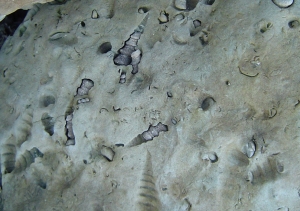
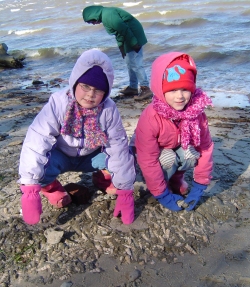 The draw at Fairview is huge numbers of turret snails -- internal molds, shells, and various combinations of the two. These are from the late Paleocene period (Aquia formation), roughly 60 million years old -- the same period as across the Potomac at Purse St. Park. You can't walk a few feet on the beach with stepping on these fossils. It is astounding how many are there, imbedded in the boulders and lying on the beach.
Our next stop was the Caledon Natural Area, a state-run bald eagle sanctuary a few miles downstream from Fairview. Much of the area is closed, but some of it is open during the winter (after the eagles have finished nesting). In the off-season, you can walk about 1.5 miles down to the river, and there is a short stretch of beach that you can explore. This is obviously not prime fossil hunting ground; you can't get near any bluffs and the literature about the park does not even mention fossils. But it is a beautiful spot nevertheless, and I imagine the chances of seeing eagles working the water is pretty good, especially in the morning on a calm day. We did find one tooth on a day when the water was high and very rough. You would probably have better luck on a calm day at low tide. And even if you don't, the hiking is nice.
We ended up at Westmoreland State Park, further downstream. Westmoreland is much more well-known for fossils. They have huge cliffs; in fact, the area is a dead ringer for Calvert Cliffs State Park. Like Calvert, it is a Miocene exposure, a series of short beaches and crumbling cliffs. The cliffs have actually been closed for a while because of a huge slide they had in the summer of 2003. Unfortunately, this severely limits the fossil hunting. I hear there is good stuff to be had here, but I think you would need a boat, or be willing to run the risk of being hauled in by a ranger. Or maybe get lucky on a calm winter day. The Pope's creek area by Washington's Birthplace just upstream from Westmoreland is also a good area, from what I've heard. But the riverfront area has been placed off-limits for fossil-hunting.
 Carmel Church Quarry. This is the real deal. A unique exposure that goes from Eocene to Miocene and more recent in one compact spot. It has an extremely rich Miocene layer right on top of an Eocene layer, and it is loaded with marine mammal bones, among other things. It is closed to the public, and used for research by the Virginia Museum of Natural History, but they allow collectors in periodically. VMNH has a web page on this quarry and other sites.
We went to Carmel Church on 11/18/2004, with a group of about 25 people, on a trip led by Alton Dooley, the assistant curator for paleontology at VMNH. Dr. Dooley is an expert on Miocene whales, and it was hugely informative to be on a trip with him. Several people found big megaladon teeth, one guy found a huge otodus, and others found plenty of impressive makos and such.
But the most exciting part (for us) was coming across mammal bones. I found (and broke) a rib from a sea cow, and then found (and broke) part of a baleen whale skull. We also found lots of vertebrae. In general, the museum has the right to claim anything that is found; in practice, they let people take teeth, but they keep the bones. If you come across a skeleton, they take your name, and mark and close the hole to be excavated later. The holes for both the sea cow rib and the whale skull were closed once Dr. Dooley identified the finds.
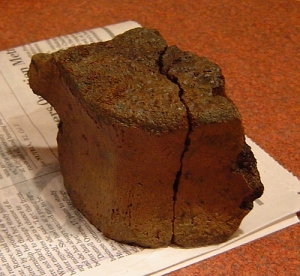
We also found several hunks of whale vertebrae, which for some reason are not as valuable as the other bones we found. We were allowed to take these home, and were amazed to find after cleaning them that two of the pieces (one that I found and one that Susan found) fit together! This is what passes for romance among fossil collectors. The vertebrae they form is 2.5" high and would be about 5" in diameter. It is apparently a tail vertebrae from a baleen whale.